
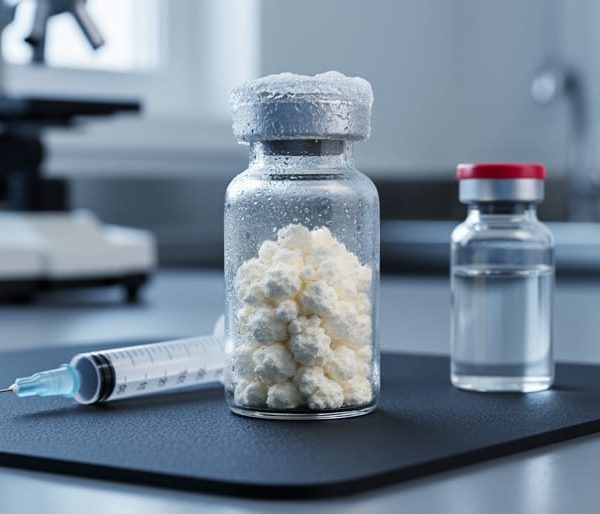
Store lyophilized Semax cold, dry and dark, then reconstitute it with a sterile, supplier-approved diluent, mixing gently and never shaking the vial. The whole procedure takes about ten minutes and requires only basic aseptic technique. The main prerequisite is the supplier’s own documentation (see https://kylopeptides.com/product/semax/), because storage temperature, diluent choice and handling limits vary by lot and formulation, and your certificate of analysis outranks any general guide, including this one.
Why does the method matter? Lyophilized peptides are stable largely because they contain almost no water. Once you introduce moisture, through condensation on a cold vial or careless handling, degradation can begin. A vial pulled from the freezer and opened immediately will pull in humid air, and a vigorous shake can damage the peptide through shear and foaming. These are small errors that quietly compromise a whole experiment, and the damage is rarely visible.
Think of it the way a good media storytelling approach treats a complex subject: clear sequence, honest limits, no overstated claims. This guide follows that model, covering tools, safety stop conditions, ordered steps and verification. If you’re sourcing material for research use only, start with the product documentation and keep it beside you at the bench.
Why Lyophilized Semax Needs Careful Handling
Lyophilization, or freeze-drying, removes water from a peptide while it is frozen, leaving a dry, porous cake. For a short synthetic peptide like Semax, that matters because water drives most of the slow chemical changes that degrade peptides, including hydrolysis of the peptide backbone and side-chain reactions. Take the water away and those processes slow dramatically. That is why the powder generally holds up better than the same peptide dissolved in solution.
The protection is conditional, though. Several factors can undermine it once the vial leaves its intended storage conditions:
– Moisture: a loose seal or a cold vial opened in humid air lets water reach the powder and restarts degradation.
– Heat: higher temperatures speed up nearly every degradation pathway, including during shipping delays.
– Light: prolonged exposure can damage susceptible residues.
– Oxidation: oxygen exposure can modify sensitive amino acids over time.
– Repeated freeze-thaw: cycling a reconstituted solution stresses the peptide and invites loss of active material.
– Microbial contamination: a non-sterile technique can introduce organisms that degrade or alter the solution.
These threats matter for reproducibility as much as for purity. A partially degraded stock delivers a lower effective concentration than the one on your label, so results can drift between experiments without any obvious cause.
Exact stability depends on the supplier, the purity of the lot and the formulation, including any bulking agents or salts. For that reason, the certificate of analysis and the supplier’s data sheet take priority over general rules of thumb, and this article avoids quoting shelf lives that no single source can guarantee.
Tools and Materials to Have Ready Before You Open the Vial
Reconstitution goes wrong most often before the vial is even opened, because something essential is missing from the bench. Gather everything first, so the powder spends as little time exposed as possible. Work through this checklist for qualified lab use.
- Handling tools: sterile syringes or calibrated pipettes with filter tips, and fresh alcohol swabs for the stopper.
- Handling tools: a calibrated analytical balance or volumetric tools, if your protocol calls for weighing or precise dilution.
- Handling tools: appropriate PPE, including gloves, a lab coat and eye protection.
- Solvents and containers: a suitable solvent, such as sterile or bacteriostatic water, or whatever the supplier or your protocol specifies.
- Solvents and containers: low-protein-binding sterile tubes for aliquots.
- Solvents and containers: a desiccator and opaque or amber containers for storage, which are helpful extras.
- Documentation: the vial itself and its certificate of analysis.
- Documentation: labels, plus a lab notebook or inventory log.
- Documentation: a refrigerator and freezer with temperature monitoring.
Take a moment to read the certificate of analysis against the vial label, since lot number, labeled peptide amount and supplier storage guidance all feed into later steps. Confirm that your solvent is sterile and within its expiry date, and that tubes and tips are sealed until use. If any item is missing, pause rather than improvise, because substitutions are a common source of avoidable variability in peptide work.
Safety Warnings and Stop Conditions Before You Begin
Semax is supplied as a research material, and the guidance in this article is written for qualified laboratory personnel working under their institution’s policies, local regulations and the supplier’s safety data sheet (SDS). Read the SDS before you open anything, and confirm that your protocol has been approved for this work.
Standard protective equipment applies: lab coat, gloves and eye protection. Work in a clean, designated area, and use a fume hood or biosafety cabinet if your institution requires one for fine powders. Lyophilized material can disperse easily when a stopper is disturbed, so open vials gently and avoid inhaling any powder. Keep your technique aseptic throughout, from sanitizing the stopper to using sterile syringes or filter tips. Handle needles and syringes as sharps, and dispose of them immediately in an approved sharps container without recapping.
Before you begin, check for these stop conditions:
– A cracked or damaged vial, or a broken or loose seal
– A cake that is discolored, collapsed or visibly damaged
– Missing documentation, including the certificate of analysis
– Evidence of a temperature excursion during shipping
– An unclear chain of custody
If any of these apply, do not proceed. Quarantine the vial, label it clearly, record what you observed and contact the supplier. Taking that pause protects both your safety and the integrity of your data.
How to Store Lyophilized Semax Before Reconstitution
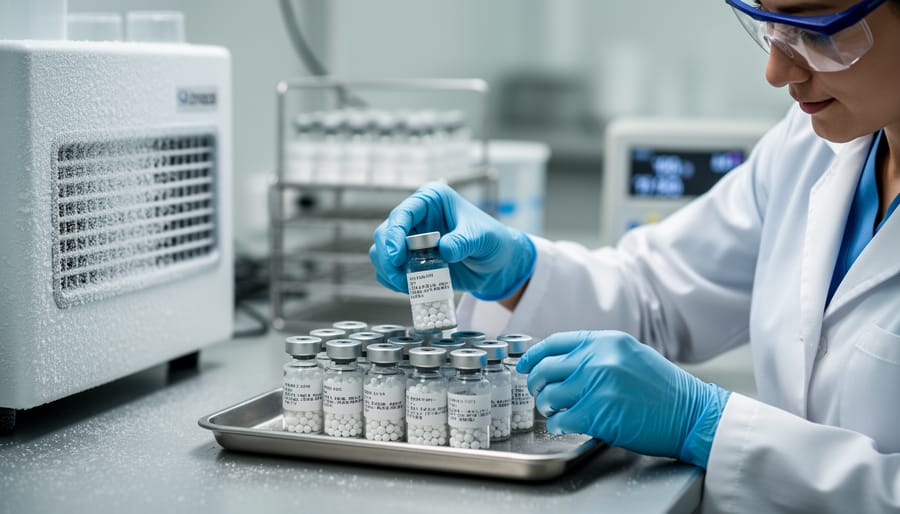
Storage starts the moment the package arrives. Inspect the shipment before anything goes into a refrigerator or freezer. Check that the vial is intact, the seal is unbroken, the cake looks like the supplier described, and the paperwork matches the label. Then record the lot number, receipt date, supplier and storage location in your inventory log. If anything looks off, apply the stop conditions covered earlier and quarantine the vial.
Keep the vial sealed until you are ready to reconstitute. For storage temperature, follow the supplier’s data sheet and certificate of analysis above all else. As typical practice, short holding periods are often done refrigerated, while longer-term storage of lyophilized peptides is commonly done at freezer temperatures, often around -20 °C. Treat these figures as a starting point to confirm, not a rule.
Protect the powder from light and moisture. Keep the vial in its original packaging or an opaque or amber secondary container, and consider a sealed box with desiccant or a desiccator to limit humidity. Where you can, use a freezer with continuous temperature monitoring and an alarm. Frost-free freezers cycle through warming phases to melt ice buildup, which can subject vials to repeated small temperature swings, so a manual-defrost unit is the better choice if one is available.
Before opening, let the vial come fully to room temperature while still sealed. Opening a cold vial draws moist air onto the powder, and condensation can compromise a peptide that has been carefully kept dry. Allow time for the vial to equilibrate, and log any deviations from your normal routine.
Step-by-Step Process for Reconstituting Semax
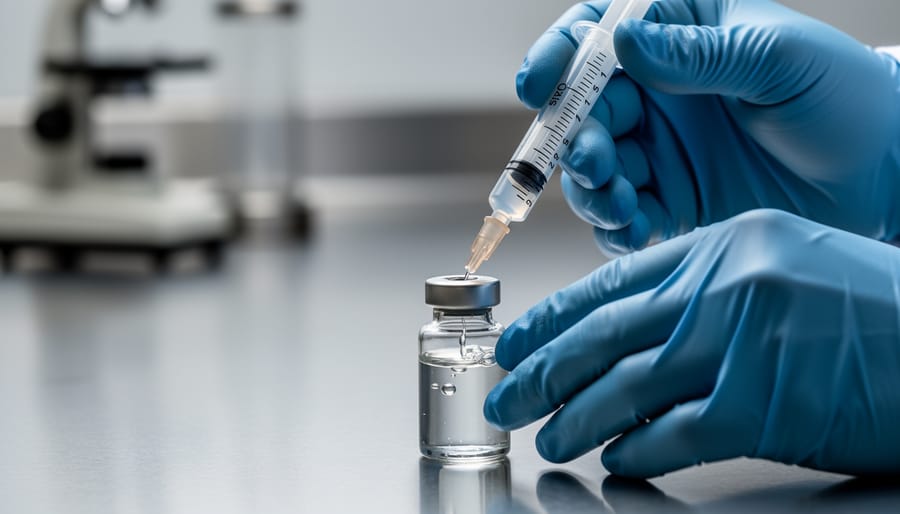
Reconstitution is a short procedure, but each step guards against a specific failure: contamination, condensation, mechanical stress on the peptide, or a concentration error that quietly skews every downstream assay. Work in a clean area, wear your PPE, and follow the order below.
- Confirm the lot and documentation. Match the vial label to the certificate of analysis and your inventory log, so every result traces back to a known lot.
- Equilibrate the vial to room temperature. Opening a cold vial draws condensation onto the powder, which introduces moisture you spent the storage period excluding.
- Sanitize the stopper. Wipe it with an alcohol swab and let it dry, so you are not pushing surface contaminants through the septum.
- Choose the solvent and calculate the concentration. Use the solvent your supplier or protocol specifies, and work out the volume from the labeled peptide amount before you draw anything.
- Draw the solvent with a sterile syringe or filter-tip pipette. Measuring it precisely keeps the final concentration close to your calculation.
- Add the solvent slowly down the inner wall of the vial. Directing it away from the cake avoids a forceful jet that can foam or stress the peptide.
- Swirl gently until dissolved. Avoid vigorous shaking or vortexing, which creates bubbles and can damage the peptide. Allow a few minutes if the cake dissolves slowly.
- Inspect the solution. It should be clear and free of particulates; anything cloudy or fibrous is a reason to stop and consult the supplier.
- Record the details. Log the volume, concentration, date, lot and handler, so the preparation can be reproduced and audited later.
The concentration calculation is simple division. As an illustrative example only, suppose the label states 5 mg of peptide per vial and you add 2 mL of solvent. The result is 5 mg ÷ 2 mL = 2.5 mg/mL. If your protocol calls for 1 mg/mL, you would instead add 5 mL. Always rely on the actual labeled amount and your own protocol rather than these example figures.
Take your time at the dissolution step. A cake that takes a few minutes to dissolve is normal, and rushing it with agitation is a common source of avoidable variability.
Storing the Reconstituted Solution and Aliquoting
Once Semax is in solution, treat it as the more fragile form of the material. Water reintroduces the hydrolysis and degradation pathways that lyophilization was designed to hold back, so a solution is generally less stable than the powder it came from. For that reason, plan your use of the solution before you start rather than improvising afterward.
For short-term use, keep the solution refrigerated and shielded from light, for example in an amber tube or a lidded box. If you will not use the full volume soon, divide it into aliquots in sterile, low-protein-binding tubes straight away. Each aliquot should hold roughly what one experiment needs, which limits repeated freeze-thaw cycles and keeps you from returning to the same container again and again.
Label every aliquot with concentration, preparation date and lot number, and mirror those details in your handling log. A tube you cannot trace is a tube you cannot trust.
Avoid repeated needle entries into a single vial, because each puncture is a chance for contamination. Pull what you need once, into clean tubes, and work aseptically.
Set a conservative use-by window based on your own validation or the supplier’s guidance rather than on assumption. Discard any aliquot that looks cloudy or contains particulates. When in doubt, discard it.
Verifying Your Results and Planning Next Steps
Verification begins at the bench. Check that the reconstituted solution is clear and free of visible particulates, then cross-check the calculated concentration against your records: labeled peptide amount, solvent volume and the resulting figure. Review the documentation for completeness, including lot number, date, handler and any deviations from the planned procedure.
Where the research justifies it, confirm identity and purity analytically. HPLC purity checks and mass spectrometry, run through a qualified lab, can show whether the material matches the certificate of analysis. Periodic stability checks on stored aliquots are also worth scheduling, since they replace assumptions about shelf life with your own data.
Keep a handling log that records every step from receipt to final aliquot, so results can be traced and reproduced. Then revisit your internal SOPs and update them with anything the run taught you.
Scientific integrity means recording deviations honestly, such as a brief temperature excursion or a slightly cloudy first draw, and letting them inform how you interpret the data. Clear, shared records also make it easier to compare methods across labs, much as international collaboration relies on transparent, comparable documentation to turn individual findings into dependable knowledge.
Common Questions About Storing and Reconstituting Semax
Most questions about Semax handling come down to the same principle: follow the supplier’s documentation first, then your institution’s SOPs. The answers below are general practice, not universal rules.
What solvent should be used?
Use the solvent named on the supplier’s data sheet or in your protocol, most often sterile or bacteriostatic water. If neither specifies one, validate your choice internally before relying on it.
How long can reconstituted Semax be kept refrigerated?
There is no single answer, because stability depends on purity, formulation and solvent. Set a conservative use-by window from supplier guidance or your own validation, and discard anything cloudy.
Can it be refrozen after thawing?
Repeated freeze-thaw cycles are best avoided, which is why aliquoting into low-protein-binding tubes is recommended. Treat a thawed aliquot as single-use unless your validation shows otherwise.
Why should the vial warm up before opening?
A cold vial draws condensation onto the powder, and added moisture speeds degradation. Letting it reach room temperature while sealed prevents this.
Two practical points remain. If the powder looks clumped or the cake seems reduced, quarantine the vial and contact the supplier rather than proceeding, since you cannot tell whether moisture or a temperature excursion is responsible. For concentration, divide the labeled peptide amount by the solvent volume you add, and record both figures in your log. Clear, consistent records are a form of scientific communication letting colleagues reproduce your work and interpret your data with confidence.
Every careful peptide lab comes back to the same few habits. Keep the powder cold, dry, dark and sealed. Let the vial warm before opening, reconstitute gently with sterile technique, then aliquot the solution and record each step. None of it is complicated, but all of it is easy to skip when a deadline is close.
The lab from our opening learned that lesson the hard way, tracing erratic results to a single shortcut at the bench. Good handling is what lets another group reproduce your work, much as international cooperation depends on shared, trusted standards. Take an hour this week to review your SOPs and update them.