

International cooperation is the voluntary coordination of policies, resources, and actions among sovereign nations or their institutions to achieve shared objectives that cannot be met effectively by individual countries acting alone. This process encompasses formal treaties, multilateral agreements, joint research initiatives, technology transfer programs, and collaborative frameworks that address challenges spanning borders, from climate change and public health to energy security and sustainable development.
The concept matters profoundly in 2026 because global challenges have outpaced the capacity of any single nation to respond effectively. Climate targets require synchronized emission reductions across continents. Electric vehicle charging infrastructure demands standardized protocols to enable cross-border travel. Renewable energy grids increasingly rely on interconnected systems that balance supply and demand across multiple jurisdictions. Without structured cooperation, these systems fragment, duplicate efforts, waste resources, and fail to deliver outcomes at the necessary scale.
This article provides a working definition grounded in contemporary practice, explains the mechanisms through which cooperation functions, distinguishes between bilateral, multilateral, and regional cooperation models, and examines real-world applications in sustainable transport and clean energy. Rather than treating cooperation as abstract diplomacy, the focus remains on the practical frameworks that enable countries to share technology, harmonize standards, pool funding, and coordinate policy in sectors critical to the global energy transition.
Understanding international cooperation clarifies how progress occurs when national interests align with collective benefit, how institutions translate political commitments into technical action, and why the pace of change in areas like transportation electrification and renewable deployment depends as much on international coordination as on domestic innovation.
What International Cooperation Means in Today’s Global Landscape

International cooperation is the voluntary, cross-border process through which countries, organizations, and stakeholders align resources, knowledge, and policies to tackle problems too large or complex for any single actor to solve alone. Unlike coordination, which typically involves a central authority directing activities toward a predetermined plan, cooperation emerges from mutual interest and shared goals, where partners contribute on their own terms while working toward compatible outcomes. In 2026, this distinction matters enormously in sustainable mobility, energy transition, and electrification policy, where rapid technological change and urgent climate targets demand both agile collaboration and structured governance frameworks.
At its core, international cooperation rests on the principle that collective action yields better results than isolated efforts. When the European Union, Japan, and South Korea work together on battery safety standards for electric vehicles, they do not surrender regulatory independence. Instead, they create a shared technical baseline that manufacturers can build to, reducing compliance costs and accelerating market growth across borders. The same logic drives research consortia pooling data on charging infrastructure performance or nations exchanging lessons learned from zero-emission bus deployments.
- International cooperation
- A voluntary process where nations, organizations, and stakeholders work across borders to achieve shared objectives through mutual support, knowledge exchange, and aligned action.
- Bilateral cooperation
- Collaboration between two parties, such as two countries partnering on a joint electric vehicle infrastructure project or a shared renewable energy research initiative.
- Multilateral cooperation
- Engagement involving three or more parties, often coordinated through international bodies like the International Energy Agency or regional policy platforms.
- International collaboration
- A closely related term often used interchangeably with cooperation, though it can emphasize joint execution of specific projects or research programs rather than broader alignment of interests.
- Cross-border partnerships
- Formal or informal agreements enabling stakeholders from different jurisdictions to share resources, data, or responsibilities in pursuit of common goals.
Cooperation can be formal or informal. Formal cooperation materializes in binding treaties, memoranda of understanding, or joint task forces with defined roles and timelines. UN vehicle regulation harmonization exemplifies this, bringing together governments to create globally consistent safety and environmental standards for cars and trucks. Informal cooperation happens when research institutions exchange datasets, industry associations share best practices, or NGOs coordinate advocacy campaigns without legal frameworks. Both modes are essential: formal structures provide accountability and scale, while informal networks enable rapid adaptation and grassroots innovation in fast-moving fields like electromobility.
How International Cooperation Works in Practice
The Role of Trust and Mutual Benefit
Trust forms the foundation of any effective international cooperation effort. Without it, nations and organizations hesitate to share data, align policies, or invest resources in joint initiatives. In the context of sustainable mobility and zero-emission transport, trust emerges when partners demonstrate consistent transparency in their research methodologies, openly share findings even when results challenge existing assumptions, and maintain scientific integrity over political convenience.
Mutual benefit acts as the practical glue that sustains cooperation over time. Partners continue collaborating when they perceive tangible returns: access to complementary expertise, cost-sharing on expensive infrastructure projects, enhanced credibility through association with respected institutions, or accelerated policy influence. A European research consortium studying battery lifecycle impacts, for instance, attracts global participation because each member gains insights they couldn’t develop alone while contributing unique data from their national context.
Reciprocity reinforces these dynamics. When one partner shares proprietary emissions data, others feel obligated to contribute their own findings. This exchange creates a self-reinforcing cycle where transparency begets more transparency, strengthening the collective knowledge base. The relationship breaks down when participants perceive imbalance, one party extracting value without contributing, which is why successful cooperation frameworks establish clear expectations for data sharing, resource commitments, and credit attribution from the outset.
Governance Structures That Enable Collaboration
Successful international cooperation relies on deliberate organizational frameworks that turn goodwill into tangible outcomes. Task forces bring together technical experts and policymakers for time-bound objectives, such as harmonizing electric vehicle charging standards across Europe or establishing cross-border hydrogen corridors. They operate with clear mandates, defined deliverables, and sunset clauses that prevent indefinite meetings without results.
Steering committees provide strategic oversight, typically comprising senior officials who set priorities, allocate resources, and resolve conflicts that working-level teams cannot. In renewable energy research collaborations, steering committees ensure national contributions align with shared scientific goals while respecting each participant’s sovereignty.
Technical working groups handle the substance: scientists, engineers, and industry specialists who draft standards, analyze data, and produce the research outputs that inform policy. These groups function best with rotating leadership, transparent documentation, and mechanisms for minority viewpoints, ensuring legitimacy across diverse stakeholder interests.
The most effective structures embed accountability through regular reporting cycles, peer review processes, and independent evaluation. Without governance that balances flexibility with discipline, international cooperation drifts into talk shops rather than driving measurable progress.
Forms of International Cooperation: From Bilateral Ties to Global Networks
International cooperation takes multiple forms depending on the goals, participants, and geographic scope of the partnership. Each structure offers distinct advantages for different challenges in sustainable transport and energy.
Bilateral cooperation links two nations or organizations through direct agreements, memoranda of understanding, or joint research programs. This model allows for tailored partnerships that reflect mutual priorities. For instance, a bilateral agreement between Norway and the Netherlands on electric vehicle charging infrastructure enabled both countries to share technical standards and deployment lessons while maintaining control over domestic policy. These two-party arrangements excel when partners have aligned interests, compatible regulatory frameworks, and clear complementary strengths. Bilateral research agreements between a national energy agency and an academic institution can advance zero-emission technology development faster than broader coalitions, particularly when intellectual property protection and focused objectives matter.
Regional cooperation brings together neighboring or economically linked countries to harmonize policies, align standards, and pool resources. The European Union’s Clean Vehicles Directive exemplifies this approach, creating consistent procurement rules and emissions standards across member states to accelerate the transition to zero-emission transport. Regional bodies such as ASEAN coordinate renewable energy targets and cross-border grid integration, reducing duplication and enabling economies of scale. This form works best when participants face shared challenges, air quality in a metropolitan corridor, renewable energy integration across interconnected grids, and when regulatory alignment delivers efficiency gains that justify the coordination effort.
Multilateral cooperation operates at the global scale through institutions such as the United Nations Framework Convention on Climate Change, the International Energy Agency, and specialized agencies focused on transport and energy policy. These platforms set international norms, facilitate knowledge exchange among dozens of countries, and mobilize resources for large-scale initiatives. The IEA’s Electric Vehicles Initiative, for example, coordinates research and policy dialogue across 20 member governments, creating a forum where diverse perspectives inform global best practices. Multilateral structures suit challenges that transcend regions, climate mitigation, technology standardization, capacity building in emerging markets, but require patience and diplomatic skill to navigate varied national interests.
Networked cooperation emerges through industry consortia, research platforms, and NGO-led coalitions that operate across borders without formal government treaties. These flexible arrangements often move faster than intergovernmental processes. Consider the CharIN consortium, which unites automakers, charging providers, and utilities worldwide to develop the Combined Charging System standard, or the global network definition embodied by international research collaborations that link universities, industry partners, and NGOs around shared bioenergy or electromobility challenges. Networked models thrive when innovation speed, technical problem-solving, and stakeholder inclusivity matter more than binding legal commitments.
The most effective international cooperation efforts often combine these forms:
- Bilateral research agreements that feed findings into regional policy harmonization
- Regional policy alignment informed by multilateral standards-setting bodies
- Global institutions that provide data and frameworks for bilateral partnerships
- Industry-academic partnerships within networked consortia that support government multilateral initiatives
- NGO-led advocacy coalitions bridging bilateral, regional, and multilateral processes to amplify credible research
Choosing the right form depends on the specific objective. Bilateral ties offer speed and specificity; regional cooperation delivers scale and regulatory coherence; multilateral platforms provide legitimacy and global reach; networked models enable agility and cross-sector innovation. In practice, advancing zero-emission mobility and sustainable energy requires all four operating in concert, with each structure contributing where it adds the most value.
Where International Cooperation Makes an Impact
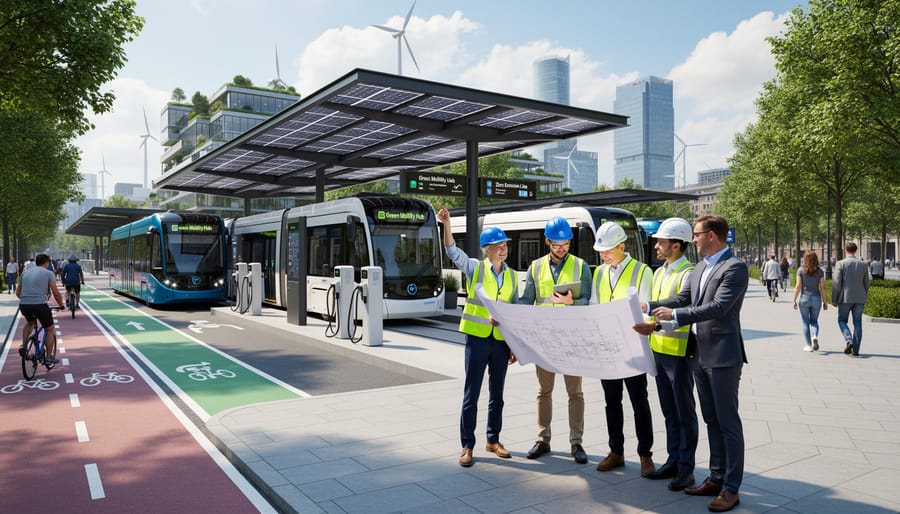
International cooperation yields tangible outcomes where national borders would otherwise fragment progress. In sustainable transport policy, joint efforts harmonize technical standards, emission testing protocols, and safety requirements that allow electric vehicles and charging infrastructure to function across borders. The EU’s coordinated approach to plug compatibility and battery regulations demonstrates how aligned policy frameworks reduce market fragmentation and lower costs for manufacturers and consumers alike.
Zero-emission technology development accelerates when research institutions and industry partners pool expertise and funding. Collaborative programs in battery chemistry, hydrogen fuel cells, and grid integration solve problems no single entity could tackle efficiently alone. Shared facilities, joint patents, and coordinated testing protocols eliminate redundant efforts while spreading financial risk across participants. Knowledge circulates faster through formal networks than through competitive siloing, shortening the path from laboratory discovery to commercial deployment.
Energy system integration benefits substantially from cross-border cooperation, particularly where renewable generation in one region complements demand patterns or storage capacity in another. Joint grid planning, interconnection investments, and coordinated dispatch protocols optimize the use of variable renewable sources. These arrangements require technical alignment and mutual commitment, but they deliver reliability and cost advantages that isolated national systems cannot match.
Legislative advocacy gains credibility and reach through international cooperation. When research consortia, NGOs, and industry coalitions present unified findings, backed by rigorous, transparent methodology, policymakers encounter consistent messages across jurisdictions. This amplification effect makes credible science harder to dismiss and accelerates evidence-based regulation. Coordinated electrical mobility advocacy has shaped emissions targets, subsidy structures, and public procurement rules in multiple markets simultaneously, creating momentum that no single lobby could generate.
Knowledge sharing through international platforms addresses practical implementation challenges collectively. Forums focused on EV infrastructure challenges like urban charging deployment, grid capacity planning, or cold-climate performance, allow stakeholders to learn from successes and failures across diverse contexts. This exchange prevents reinventing solutions, identifies best practices faster, and builds a shared evidence base that informs smarter investment decisions. When countries face similar transitions, pooled learning compresses timelines and reduces costly missteps.
Challenges and Enablers of Effective International Cooperation
International cooperation faces predictable challenges that can slow or derail even well-intentioned partnerships. Political independence concerns often surface when governments worry that collaboration will limit their sovereignty or force compromises on domestic priorities. Resource asymmetries between wealthier and developing nations create imbalances in bargaining power and capacity to contribute, leading to participation gaps and unequal influence over outcomes. Conflicting national interests, such as competing industrial strategies or divergent timelines for phasing out fossil fuels, can stall negotiations and fragment consensus. Communication barriers, including language differences, technical jargon, and cultural norms around decision-making, add friction that slows progress and breeds misunderstandings.
Strong governance structures overcome these obstacles by establishing clear roles, transparent decision-making processes, and accountability mechanisms that build confidence among partners. Scientific integrity acts as a unifying force: when cooperation rests on credible, peer-reviewed evidence rather than political posturing, stakeholders can align around shared data and trusted research, reducing disputes over facts. Inclusive stakeholder engagement, bringing industry, academia, NGOs, and government to the table from the outset, ensures that diverse perspectives shape solutions and no critical voice is sidelined. Strategic communication, both within the partnership and to external audiences, maintains momentum by keeping goals visible, celebrating milestones, and managing expectations.
Lessons from global electromobility initiatives show that early investment in governance frameworks and shared research platforms pays dividends. Similarly, efforts to navigate biofuels policy conflicts demonstrate that acknowledging trade-offs openly and framing cooperation around mutual long-term benefits, like energy security and emissions reduction, can bridge competing interests. When partners commit to transparency, respect scientific evidence, and design structures that distribute power equitably, international cooperation becomes resilient enough to deliver results despite inherent tensions.

International cooperation stands as the deliberate, cross-border effort where nations, organizations, and stakeholders unite around shared goals that no single actor can achieve alone. Throughout this exploration, we’ve seen how these collaborative frameworks, from bilateral agreements to global research networks, turn ambitious sustainability targets into actionable pathways.
In zero-emission mobility and sustainable energy, cooperation isn’t merely beneficial; it’s foundational. The transition to electric vehicles, the integration of renewable energy systems, and the development of climate-resilient transport infrastructure all demand knowledge exchange, policy harmonization, and coordinated investment that transcends national boundaries. When governments align regulatory standards, when research institutions share breakthrough findings, and when industry partners co-develop charging infrastructure across regions, the pace of innovation accelerates and adoption barriers fall.
Looking ahead, the complexity of climate challenges will only deepen the interdependence among stakeholders. The most effective solutions will emerge where scientific integrity meets inclusive governance, where trust enables resource sharing, and where diverse voices, from vehicle manufacturers to policy makers to civil society, contribute expertise. International cooperation won’t solve every challenge, but it creates the conditions where meaningful progress becomes possible. For professionals navigating this landscape, understanding how cooperation works and where it delivers impact remains essential to shaping the sustainable mobility systems our future requires.
Frequently Asked Questions
What’s the difference between cooperation and collaboration?
Cooperation is a broader term describing voluntary coordination toward shared goals, often with distinct roles and contributions. Collaboration implies deeper integration, with partners working jointly on specific tasks or projects, sharing resources and decision-making authority more closely.
How do countries decide to cooperate?
Countries typically enter cooperation when they identify shared challenges or opportunities that exceed individual capacity, such as climate mitigation, technology development, or infrastructure integration. Political will, mutual benefit, and trust established through preliminary dialogue determine whether formal agreements or informal arrangements emerge.
What makes international cooperation successful?
Success hinges on clear governance structures, transparent communication, and genuine reciprocity. Partners must maintain scientific integrity, ensure inclusive stakeholder engagement, and align incentives so each party gains meaningful value while advancing collective objectives.
How does international cooperation influence policy?
Cooperation provides evidence, technical standards, and shared frameworks that inform national and regional policy design. When credible research institutions and industry bodies collaborate across borders, their findings and recommendations carry greater weight in legislative debates and regulatory processes.
Can private organizations participate in international cooperation?
Absolutely. Vehicle manufacturers, technology firms, research centers, and NGOs regularly join cooperation frameworks alongside governments. Their technical expertise, implementation capacity, and market insight are essential for translating high-level agreements into operational standards and real-world solutions in electromobility and sustainable energy.
These questions reflect the practical concerns stakeholders face when navigating international cooperation in sustainable transport and energy. Understanding the nuances between cooperation models helps organizations choose the right engagement strategy, whether joining a multilateral research consortium, contributing to bilateral technology transfer, or participating in regional policy harmonization efforts.
The path forward depends on recognizing that effective cooperation is neither automatic nor purely transactional. It requires sustained commitment, adaptive governance, and a willingness to align local priorities with broader global objectives. For those working in zero-emission mobility, renewable energy, or climate policy, mastering these dynamics means your organization can shape outcomes rather than simply respond to them.